
You will now have a list of people and organisations that are potentially or directly affected by your work. Some of these may have the power to advance it or create obstacles to that work. Some may be interested in what you are doing, while others may not be interested or understand how the project may impact them. However, given the importance of addressing health inequalities you need to work out who you need to prioritise.
This prioritisation is usually done by classifying stakeholders according to their influence over your work and their interest in it, on a power/interest grid (see figure 1).
The influence/interest grid is used to identify key stakeholders that have a high level of power and interest in a project, and therefore need to be managed closely.
Figure 1: Influence/interest grid for stakeholder prioritisation
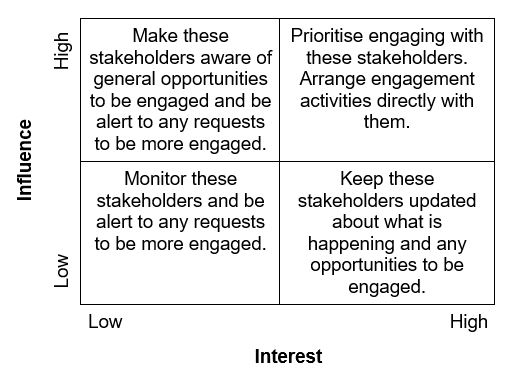
The position that you allocate to a stakeholder on the grid indicates what kind of actions you need to take with them:
- High influence, highly interested people (work closely with): you must fully engage these people and make the greatest efforts to satisfy them. Communication should be designed to engage.
- High influence, less interested people (keep satisfied): these are sometimes people that you want to involve more closely, but who may not initially be interested. You will want to ensure that you keep them well informed and give them opportunities to be involved.
- Low influence, highly interested people (keep informed): adequately inform these people and talk to them to ensure that no major issues are arising.
- Low influence, less interested people (monitor): these are people who are unlikely to be involved. Communication should be open and transparent so they can find out as much as they want to.
It is possible that, over time, stakeholders in one section of the grid may move to another section. Therefore, it is important to continuously review your stakeholder map throughout your project. It is important to consider how you will track and evaluate; your relationship with your stakeholders, the influence certain stakeholders have other one another and stakeholder activity.
Another important point to note is that groups with minimal power or interest are sometimes overlooked. However, people in these groups can influence others, and their interest levels may change.